
Last updated July 15, 2026
Gate Repair Permits, Codes & Inspections in TX: What You Need to Know
Almost nobody pulls a permit for gate repair. And for most standard repairs, that’s fine — replacing a broken spring, swapping a dead control board, or reprogramming a LiftMaster keypad doesn’t touch the building code at all. But the line between repair and modification is blurrier than most contractors admit, and the City of Frisco’s Development Services department has its own interpretation of where that line falls — one that differs meaningfully from what you’ll find in Plano, McKinney, or Allen. Get it wrong, and you won’t find out until a title examiner flags your property or your homeowner’s insurance denies a claim. This guide — along with our Seasonal Gate Repair Care for Frisco: Year-Round Homeowner’s Guide — tells you exactly what triggers a permit in Texas, what the inspection process actually looks like, and how HOA review layers on top of city code in Frisco’s master-planned communities.
Quick Answer
In Texas, most routine gate repairs — motor replacement on a like-for-like basis, sensor adjustments, hinge welding, and control-board swaps — do not require a building permit. However, any gate work that changes the structure’s footprint, height, or electrical configuration, or that involves a new automated operator where none existed before, typically triggers a permit requirement under the Texas Residential Code and Frisco’s local amendments. Doing modification work without a permit creates a disclosure obligation during real estate transactions and can void certain homeowner’s insurance provisions — two problems that rarely surface until they’re expensive.
Table of Contents
- What Actually Triggers a Permit in Frisco, TX
- Work That Generally Doesn’t Require a Permit
- How HOA Architectural Review Intersects With City Permitting
- Unpermitted Gate Work and Real Estate Transactions
- Access Control and Low-Voltage Wiring: When You Need a Licensed Electrician
- The Inspection Process: What Frisco Inspectors Actually Check
- Common Mistakes to Avoid
- When to Call a Professional
- Frequently Asked Questions
- The Bottom Line
What Actually Triggers a Permit in Frisco, TX
Frisco’s Development Services department bases permitting decisions on the 2021 International Residential Code (IRC) with local amendments, which Texas adopted as the foundation of its statewide residential building framework. Under that framework, the operative test is straightforward: does the work constitute new construction, addition, alteration, or repair of a structure beyond a defined threshold? For gates, that breaks down into a few specific scenarios.
Work that typically requires a permit in Frisco:
- Installing a new automated gate operator where no automation previously existed. Adding a motor to a manually operated swing gate — even if the gate itself isn’t changing — is classified as a new installation of electrical or mechanical equipment.
- Increasing gate height beyond the existing permitted dimensions. Frisco’s fence and gate ordinance (Code of Ordinances, Chapter 110) generally limits residential fence and gate heights to 8 feet in rear yards and 4 feet in front yards; altering height requires an amendment to the original permit or a new one.
- Relocating or widening a gate opening. Moving the posts changes the structure’s footprint and requires a new permit — period.
- Adding a new 120V or 240V electrical circuit to serve an operator. Hard-wired power to a new location requires an electrical permit, regardless of who performs the gate work itself.
- Structural modifications to the gate frame or support columns. This includes replacing masonry columns or rebuilding a damaged post foundation — not just welding a cracked hinge.
When in doubt, a quick call to Frisco’s Development Services at their public counter will give you a ruling — they’re accessible and will answer direct questions about specific scopes of work without requiring you to file anything first.
Work That Generally Doesn’t Require a Permit
Texas code and Frisco’s local ordinances both include a carve-out for ordinary maintenance and like-for-like repair. The following work — done correctly — typically falls within that carve-out and does not require you to pull a permit.
- Replacing a gate operator motor with the same model or a direct equivalent (e.g., swapping a failed LiftMaster RSW12U for a new unit of identical specs on an existing automated gate).
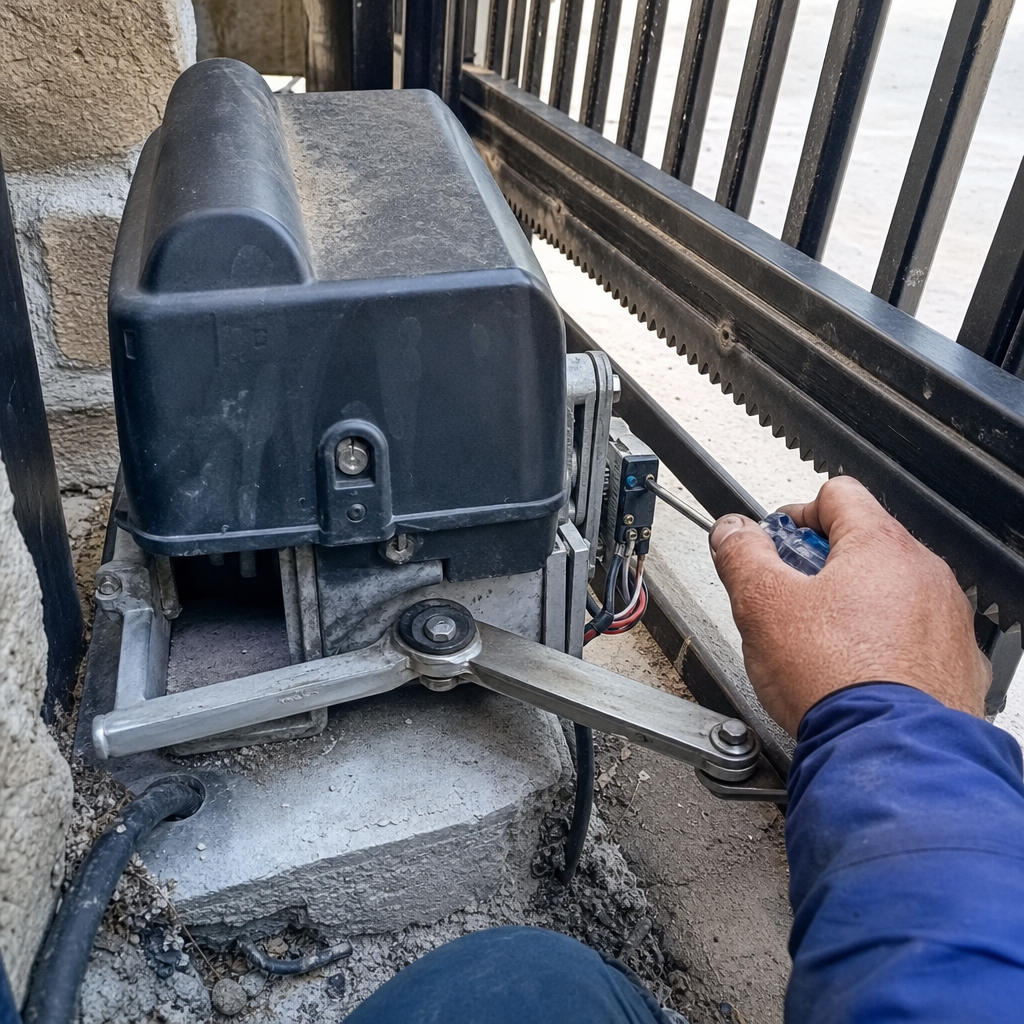
- Replacing worn or broken components: springs, hinges, rollers, arms, limit switches, safety sensors, and control boards — provided the gate’s configuration doesn’t change.
- Reprogramming or upgrading access-control logic within existing low-voltage wiring (keypads, card readers, loop detectors, intercom programming).
- Repainting or refinishing the gate surface.
- Welding a cracked gate frame member where the repair restores, rather than modifies, the original structure.
- Adjusting travel limits, open/close timing, and force settings on any existing automated operator.
- Replacing a battery backup unit or solar panel on a Ghost Controls or Mighty Mule system — provided no new wiring run is required.
The key phrase throughout is like-for-like. The moment you upgrade to a heavier-duty operator class, change the swing direction, or run new conduit, you’ve crossed from maintenance into modification — and the permitting calculus changes.
In our experience providing Gate Repair across Frisco neighborhoods from Starwood to Phillips Creek Ranch, the vast majority of service calls we handle fall cleanly in the no-permit category. The confusion almost always arises when a homeowner or a less-experienced contractor starts combining repairs with upgrades in the same visit without thinking through the code implications.
How HOA Architectural Review Intersects With City Permitting
This is where Frisco gets genuinely complicated, and where homeowners in master-planned communities consistently get tripped up. The City of Frisco’s permitting requirements and your HOA’s Architectural Review Committee (ARC) process are two separate approval chains — and passing one does not mean you’ve satisfied the other.
In communities like Newman Village, Richwoods, Westfalls Village, or Frisco Lakes, HOA covenants often specify gate aesthetics (material, color, finish, style), automation brand restrictions, and approval timelines that go well beyond what the city requires. We’ve seen situations where:
- A homeowner received city permit approval for a new sliding gate operator, but the HOA ARC denied the application because the proposed motor housing wasn’t a color-matched finish.
- An HOA approved a gate upgrade in writing, but the homeowner never pulled the required city permit — leaving them with an HOA-compliant but code-noncompliant installation.
- The HOA’s governing documents referenced an outdated Frisco fence ordinance, creating a conflict between HOA-approved dimensions and current city code.
The practical takeaway: get both approvals before work begins, in writing, and verify that your contractor understands both sets of requirements. Many general handymen and fence companies that “also do gates” don’t track HOA architectural standards — that’s a gap that shows up on your dime later. For help vetting the right pro, see How to Hire a Gate Repair Contractor in Frisco: A Step-by-Step Guide.
Also worth noting: HOA approval is not a substitute for a city permit. If the city requires a permit and you rely solely on HOA sign-off, you’re still exposed.
Unpermitted Gate Work and Real Estate Transactions
The scenario plays out more often than most Frisco homeowners expect. A property goes under contract, the buyer’s inspector flags the gate operator or the modified gate opening during the inspection, and suddenly there’s an unpermitted improvement sitting in the disclosure chain. Here’s what typically happens next — and what you can do about it.
The discovery: Texas requires sellers to disclose known material defects. An unpermitted structural or electrical modification to a gate qualifies. If a seller doesn’t know about it (because a previous owner did the work), that doesn’t eliminate the problem — title examiners and lenders can still require resolution before closing.
Resolution options, in order of complexity:
- Retroactive permit (most common). Frisco’s Development Services allows permit applications for work already performed. The contractor who does the current assessment files the permit, an inspector visits, and if the work meets code, it’s signed off. If it doesn’t, corrections are required before sign-off.
- Escrow holdback. The buyer and seller agree to an escrow holdback to cover permit and correction costs, resolved after closing. This requires both parties and typically the lender to agree.
- Seller correction before closing. The seller hires a licensed contractor to bring the work to code, pulls the permit, passes inspection, and provides documentation at closing. This is the cleanest path but requires lead time.
- Price reduction in lieu of correction. Some buyers accept a negotiated reduction. This doesn’t resolve the permit issue — the next owner still has the same problem at their closing.
The bottom line: unpermitted gate modification isn’t usually a deal-killer, but it reliably costs someone money — and the later it’s discovered, the more it costs.
Access Control and Low-Voltage Wiring: When You Need a Licensed Electrician
This is a point that causes real confusion in Texas, and it’s worth being direct about it.
Texas law defines low-voltage work — including gate access control wiring, intercom systems, loop detector installation, and keypad wiring — as work that generally falls outside the licensed-electrician requirement when it operates at 50 volts or less and is listed as Class 2 circuit wiring under the National Electrical Code (NEC Article 725). Most gate access-control work — DoorKing intercom wiring, Viking receiver installation, FAAC or BFT control board connections — operates in this range and can legally be performed by a gate technician without an electrical license in Texas.
However, the following work crosses into licensed-electrician territory:
- Installing or extending a 120V or 240V circuit from your electrical panel to a new gate operator location.
- Adding a new GFCI-protected outlet near the gate post (required by NEC 210.8 for outdoor receptacles).
- Installing transformer-based power supplies that tie into your home’s panel wiring.
- Any work that opens the main service panel.
At Smart Choice Gate Repair Frisco, when a job requires a new 120V circuit run, we coordinate with a licensed electrician for that specific piece of scope — because that’s what Texas law requires, and because doing it any other way creates liability for the homeowner. The rest of the gate system, from the Gate Motor & Opener in Frisco to the control board and access-control programming, we handle directly.
Solar-powered operators like Ghost Controls or Mighty Mule systems sidestep this issue entirely — they operate on battery/solar with no line-voltage connection, which is one reason they’re popular in Frisco neighborhoods where trenching a new circuit to a back gate would mean cutting through an established landscape.
The Inspection Process: What Frisco Inspectors Actually Check
If your gate project does require a permit, here’s what the inspection process looks like in Frisco — step by step, based on how it actually runs through the city’s Development Services office as of 2025.
- Apply for the permit online or in person. Frisco accepts applications through its online portal. You’ll need a site plan showing gate location relative to property lines, the make and model of any operator being installed, and a description of structural work if applicable. Permit fees for residential fence/gate work in Frisco typically run in the $75–$200 range depending on project valuation — confirm current fees with the city, as they adjust periodically.
- Plan review. For most residential gate permits, Frisco’s review is administrative rather than full engineering review. Turnaround is typically 5–10 business days for standard applications.
- Schedule the inspection. Once permitted work is complete, you request an inspection through the city’s online scheduling system. Inspectors are generally available within 1–3 business days of request.
- The inspection itself. Residential gate inspections in Frisco focus on: setback compliance (is the gate within the property line?), height compliance with the fence ordinance, structural integrity of posts and anchoring, operator mounting and safety-sensor installation, and — if an electrical permit was pulled separately — GFCI protection at any outdoor outlet.
- Pass or correction notice. If work passes, the inspector signs off and the permit closes. If corrections are required, you have a set window to complete them and schedule a re-inspection. Re-inspection fees apply.
- Keep the documentation. Store the closed permit and inspection sign-off with your home records. This documentation travels with the property and is what a title examiner or future buyer’s inspector will look for.
Inspectors in Frisco are experienced with automated gate systems — this is a market with a high density of HOA communities and gated residential entries, so gate-related inspections aren’t unusual for them. A well-installed system that meets the code on its face rarely has issues at inspection.
Common Mistakes to Avoid
- Assuming “repair” always means no permit required. The word repair doesn’t automatically exempt work from permitting — in Frisco, a structural repair to gate posts or columns can trigger a permit requirement even if no automation is involved. Confirm the scope with the city before work begins.
- Relying on HOA approval as a substitute for a city permit. Frisco HOAs and the City of Frisco are separate authorities. In communities like Starwood or Newman Village, getting ARC sign-off without also checking city permit requirements is a common and expensive shortcut.
- Letting a general handyman run a new 120V circuit to the gate post. Texas requires a licensed electrician for line-voltage work, full stop. Unlicensed electrical work voids homeowner’s insurance coverage for any fire or damage originating from that circuit — and Frisco’s inspectors will flag it.
- Choosing an operator brand your technician isn’t certified on. Mismatched programming — particularly with BFT, FAAC, or Elite systems — leads to misconfigured safety-force settings and non-compliant entrapment protection, which is both a safety issue and an inspection failure. Jeffrey Walker works directly with all nine brands we service, which means the operator gets configured correctly the first time.
- Not disclosing unpermitted work when selling. Texas property disclosure law requires disclosure of known material defects. Skipping disclosure to avoid a deal complication almost always makes the legal and financial exposure worse, not better.
- Doing modification work in phases to avoid triggering a permit. Some contractors split work across multiple visits to keep each visit below the permitting threshold. This strategy doesn’t hold up under scrutiny and creates a larger retroactive permitting problem if discovered.
- Skipping the retroactive permit because “nobody will check.” In Frisco’s active real estate market — where homes in Richwoods, Phillips Creek Ranch, and Frisco proper move with competitive buyer inspections — “nobody will check” is not a safe assumption. Buyer inspectors are specifically trained to identify unpermitted work.
When to Call a Professional
A broken hinge or a dead battery backup is a reasonable DIY fix. But there’s a defined set of scenarios where attempting gate work without a qualified gate specialist creates code, safety, and liability exposure that outweighs whatever you’d save on labor.
Call a professional when:
- You’re adding automation to a gate that’s never been motorized — this almost always triggers a permit requirement and involves electrical coordination.
- The gate posts or masonry columns have structural damage — this is structural repair, not maintenance.
- You’re upgrading to a commercial-grade operator like FAAC or BFT from a residential unit — the force settings, safety-sensor configuration, and entrapment-protection requirements differ significantly.
- A real estate transaction is pending and unpermitted gate work has been flagged — retroactive permitting requires a contractor who can assess code compliance and file accurately.
- The gate controls access to a property with a DoorKing or Elite access-control system — these are not consumer-grade systems and require brand-specific programming knowledge.
Gate Repair in Frisco is the core of what we do at Smart Choice Gate Repair Frisco. Jeffrey Walker personally handles jobs that require both technical depth and code awareness — 17 years of gate-exclusive work means he’s navigated every one of these scenarios. Call (940) 202-9941 for a free estimate.
Frequently Asked Questions
Do I need a permit to replace my gate opener in Frisco, TX?
In most cases, no — replacing an existing gate opener with a like-for-like or equivalent unit on an already-automated gate does not require a permit in Frisco. The exception is if you’re adding automation where none previously existed, running a new electrical circuit, or changing the gate’s structural configuration. When in doubt, call Frisco’s Development Services before the work begins — a five-minute conversation prevents a retroactive permitting problem. Call (940) 202-9941 and we can help you think through the scope before you commit to anything.
What happens if I sell my house with unpermitted gate work in Texas?
Texas requires sellers to disclose known material defects, and unpermitted structural or electrical modifications to a gate qualify. If the work is discovered during a buyer’s inspection — which is common in Frisco’s competitive market — resolution typically involves a retroactive permit, a price reduction, or an escrow holdback. The cost and complexity grow the longer it sits unresolved. Pulling a retroactive permit before listing is almost always cheaper than negotiating it mid-transaction. Call (940) 202-9941 for an assessment if you’re preparing to sell and have concerns about prior gate work.
Does my HOA approval cover city permit requirements for gate work in Frisco?
No — HOA architectural approval and City of Frisco permitting are entirely separate processes. An HOA can approve work the city requires a permit for, and vice versa. In master-planned communities across Frisco, including Westfalls Village and Richwoods, homeowners regularly obtain one approval assuming it covers both — it doesn’t. You need both approvals documented independently before work begins.
Can a gate technician run electrical wiring for a new gate operator in Texas?
It depends on the voltage. Low-voltage access-control wiring — keypads, receivers, intercom lines, loop detectors — can legally be performed by a gate technician in Texas without an electrical license, provided it operates as a Class 2 circuit under NEC Article 725 (typically 50 volts or less). Running a new 120V or 240V circuit from your panel to the gate operator requires a licensed electrician under Texas law. At Smart Choice Gate Repair Frisco, we coordinate that piece with a licensed electrician when it’s required — it’s not a scope we skip around.
How long does a gate permit take to get approved in Frisco?
For standard residential gate and fence permits, Frisco’s Development Services typically completes administrative plan review within 5–10 business days. Once permitted work is complete, inspections can usually be scheduled within 1–3 business days through the city’s online portal. The full process from application to closed permit runs 2–4 weeks for straightforward projects — longer if corrections are required at inspection. Planning for that timeline before starting work is the simplest way to avoid schedule pressure.
Is solar-powered gate automation subject to the same permit requirements?
Generally, yes — the operator type doesn’t automatically determine whether a permit is required. What matters is whether you’re adding new automation to a previously manual gate (which typically triggers a permit) or replacing an existing automated system like-for-like (which typically doesn’t). Solar-powered systems like Ghost Controls or Mighty Mule do avoid the licensed-electrician requirement for line-voltage wiring, since they operate entirely on battery and solar without a panel connection — but the gate installation permit question is separate from the electrical permit question. Confirm your specific scope with Frisco’s Development Services before work starts.
The Bottom Line
Most routine gate repairs in Texas don’t require a permit — and in Frisco, the Development Services office is reasonable to work with when you engage them upfront. For more guides & resources on keeping your gate in top shape, explore our blog. The problems arise when repair crosses into modification without anyone stopping to check the line. Adding a motor to a manual gate, running new power, changing gate height or footprint, or rebuilding structural columns — these trigger permitting requirements whether the contractor mentions it or not. Layer in HOA architectural review and the real-estate disclosure implications of unpermitted work, and the cost of cutting corners becomes very clear. Know the scope before the work starts, get both city and HOA approvals when required, and keep the documentation. That’s it.
If you have gate work coming up in Frisco and you’re not sure where it falls on the permit-or-no-permit line, call us before you start. Jeffrey Walker and the team at Smart Choice Gate Repair Frisco home have worked through this exact question on hundreds of jobs across Frisco over 17 years. We can tell you what your scope triggers, what it doesn’t, and handle the work correctly from the first visit. For a free estimate, call (940) 202-9941.
And if you’re considering a full system upgrade rather than just a repair, our Gate Installation in Frisco page covers what a properly permitted new installation looks like from start to finish.
Written by Jeffrey Walker, Owner & Lead Technician at Smart Choice Gate Repair Frisco, serving Frisco since 2009.