
Last updated July 15, 2026
The Complete Guide to Gate Repair in Frisco
Most gate failures in Frisco don’t happen without warning. Jeffrey Walker has been repairing gates across this city for 17 years, and the pattern is consistent: a remote that needs an extra press, an opener that sounds different in the morning, a gate that drags slightly on the concrete before it latches. These are signals, not quirks. By the time a homeowner calls because the gate won’t open at all, the problem is usually three months old. This guide breaks down what’s actually failing, why it fails in Frisco specifically, and what the honest fix looks like — whether that’s a $40 part or a full structural rebuild.
Quick Answer
Our Gate Repair services in Frisco, TX typically cost between $150 and $1,800 depending on whether the failure is mechanical, electrical, or structural. Most single-component repairs — limit switches, sensors, remote receivers, hinges — are completed same day. Problems rooted in post lean or foundation shift require structural correction before any opener replacement will hold, or the new unit will fail within months for the same reason.
Table of Contents
- The Three Root Causes Behind Most Frisco Gate Failures
- How North Texas Clay Soil Causes Gate Post Lean and Misalignment
- Opener Problem or Structural Problem? How to Tell the Difference
- Brand-by-Brand Failure Points: LiftMaster, FAAC, DoorKing, Viking, and More
- Repair or Replace? The Real Cost-Comparison Math
- HOA Gate Systems in Frisco vs. Residential Driveway Gates
- Gate Repair Pricing in Frisco: What to Expect
- Common Mistakes to Avoid
- When to Call a Professional
- Frequently Asked Questions
- The Bottom Line
The Three Root Causes Behind Most Frisco Gate Failures
After 17 years of gate-exclusive work in this market, the failures we diagnose trace back to three sources far more often than any other: foundation shift driven by soil movement, electrical failure in the control board or wiring, and deferred maintenance that lets small mechanical problems compound into expensive ones. Understanding which category you’re dealing with determines whether this is a one-hour visit or a multi-day structural job.
Foundation shift is the most misunderstood because it doesn’t announce itself dramatically. A post leans two degrees over 18 months. The gate starts dragging. The opener strains harder. Eventually the motor burns out — and the homeowner calls about a broken opener. The opener isn’t wrong. The post is.
Electrical failure shows up in control board faults, corroded wire connections at the post base, failed transformers, and logic board failures after power surges. Frisco sees enough storm activity — and the associated voltage spikes — that surge protection on gate systems is something we strongly recommend, not an optional add-on.
Deferred maintenance is the most preventable and the most common. Hinges that aren’t lubricated annually develop rust and binding that transfers mechanical load to the opener arm. A gate that was balanced perfectly at installation becomes a different load on the motor over time. We see this pattern constantly in neighborhoods across Frisco — from Starwood to Stonebriar to Phillips Creek Ranch — where gates were installed during construction and haven’t been serviced since. A Gate Repair Maintenance Checklist for Frisco Homeowners can help prevent this.
Knowing which root cause is driving your specific failure is the entire diagnostic job. Everything downstream — parts, labor, timeline — depends on getting that answer right first.
How North Texas Clay Soil Causes Gate Post Lean and Misalignment
This is the Frisco-specific issue that most general repair guides won’t tell you about, because it doesn’t apply the same way in other regions. The soil beneath most of Frisco is Blackland Prairie clay — one of the most expansive soil types in the country. When it absorbs moisture after a rain, it swells significantly. When it dries during summer drought, it contracts and pulls away from anything embedded in it. Gate posts set in this soil without adequate depth, diameter, or concrete footing move. Not dramatically in any single event — just steadily, seasonally, over years.
What that movement produces, mechanically, is gate misalignment. The gate that was perfectly plumb when installed now leans toward the opening path. The gap at the latch side changes. The gate starts to drag on the ground or the threshold on the low side. The opener has to push or pull against a load it was never designed to handle.
In our experience, the gates most vulnerable to this problem in Frisco are posts set in soil that wasn’t properly compacted after original construction, posts with concrete footings shallower than 36 inches, and older installations where the footing diameter was undersized for the gate’s weight.
The fix is never just adjusting the opener’s limit switches or re-hanging the gate panel. If the post has moved, it has to be corrected — either by resetting the post or, in moderate lean cases, by counter-anchoring. Putting a new opener on a leaning post is one of the most expensive mistakes a homeowner can make, because the new unit will fail for the same structural reason within 12 to 18 months.
If your gate has started dragging at the ground, check the post first. Hold a level against it. If it’s off plumb by more than half an inch, the post — not the opener — is the conversation to have.
Opener Problem or Structural Problem? How to Tell the Difference
This distinction is worth getting right before spending a dollar on parts, because misdiagnosing it is expensive in both directions. Here’s a practical framework we use on every service call.
- Disconnect the opener and move the gate by hand. A gate in good structural condition, properly hung and balanced, should swing freely with two fingers of force. If it’s stiff, dragging, or binding before the opener is involved, the problem isn’t the opener.
- Check the hinge alignment. Look at all hinges with the gate in the fully open and fully closed position. Hinges that are pulling away from the post or gate frame, showing rust streaks, or sitting at an angle indicate that weight distribution has shifted — usually because the post has moved.
- Listen to the opener under load. An opener that runs normally but the gate doesn’t move cleanly has a mechanical problem on the gate side. An opener that triggers an obstacle-detection stop immediately has either a sensor issue or a gate that’s physically stuck.
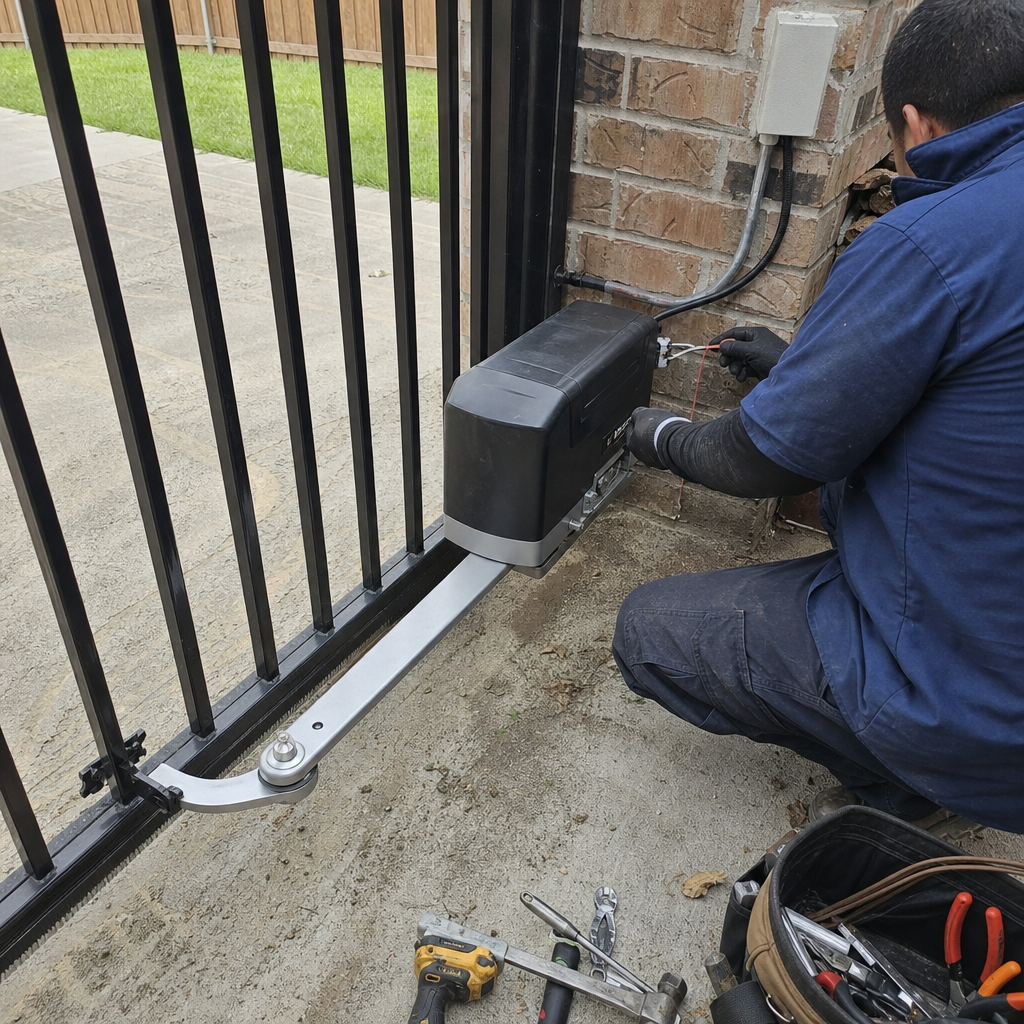
- Check the arm connection points. The bracket where the opener arm attaches to the gate and the mounting plate at the post are high-wear points. A loose arm connection will produce erratic gate behavior that looks like a control board fault but isn’t.
- Review the error code on the control board. LiftMaster, FAAC, and DoorKing boards all log fault codes. If the board is logging an overload or obstacle fault consistently, that’s the opener telling you it’s fighting a structural problem, not reporting its own failure.
The bottom line: if the gate doesn’t move freely by hand, fix the structure before touching the opener. If it moves freely and the opener still doesn’t function correctly, the problem is in the electrical and mechanical system of the opener itself.
Brand-by-Brand Failure Points: LiftMaster, FAAC, DoorKing, Viking, and More
We work on nine gate brands regularly, and each has its characteristic failure modes. Here’s what we see most often on the brands common to Frisco’s residential and light-commercial market.
LiftMaster
LiftMaster is the most common brand in Frisco subdivisions, and its most frequent failure point in this climate is the control board. Heat cycling — the kind North Texas produces with 100°F summers and hard winter freezes — stresses the board capacitors over time. We also see frequent issues with the safety sensor alignment after the gate post shifts even slightly. The sensors are precisely calibrated, and a millimeter of movement at the post changes the beam angle enough to trigger false obstacle detection.
FAAC
FAAC openers are common in higher-end Frisco communities and on heavier ornamental iron gates. Their hydraulic units are generally very durable, but the hydraulic fluid degrades in extreme heat over 5–7 years and causes sluggish operation that’s often mistaken for a motor problem. Topping off or replacing the hydraulic fluid is a fraction of the cost of replacing the unit — but only if it’s caught before the pump is damaged from running low.
DoorKing
DoorKing is common in Frisco HOA access-control applications — telephone entry systems, keypads, card readers. The most frequent failure we service is corrosion in the wiring harness at the base of the entry unit, driven by irrigation overspray and standing water. The second is programming loss after a power outage, which requires re-entry of resident codes and access parameters — a job that looks intimidating to a building manager but is straightforward when you know the platform.
Viking
Viking slide gate operators perform reliably but have a specific vulnerability: the drive rack that runs along the gate’s bottom rail accumulates debris — leaves, gravel, compacted soil — and the drive pinion grinds against obstructed teeth. This is a maintenance issue, not a manufacturing defect, but ignoring it long enough causes pinion wear that requires parts replacement.
Ghost Controls, Mighty Mule, and Elite
These brands are common on residential swing gates throughout Frisco’s newer residential areas. They’re battery-dependent systems that typically run on solar-assist charging. The most common failure we see is battery degradation after two to three years, followed by solar panel fouling from pollen and dust — both of which reduce charging efficiency and cause the gate to lose power mid-cycle. These are inexpensive repairs, but homeowners often assume the opener has failed when the battery is the actual problem.
BFT and Linear
BFT operators show up on custom residential and estate gates in Frisco. The worm gear mechanism is durable but sensitive to moisture intrusion — the seal condition on the housing should be checked annually. Linear access systems, often integrated with telephone entry, share DoorKing’s vulnerability to wiring corrosion at grade level and benefit from the same proactive waterproofing approach.
Repair or Replace? The Real Cost-Comparison Math
This is the question we get on nearly every service call for older gates, and the honest answer depends on a calculation most repair guides skip: what’s the total cost of the repair relative to the expected remaining service life of the gate system?
Here’s the framework we use:
- If the gate structure is sound and the opener is the only failure: Repair the opener or replace the motor unit. A LiftMaster or FAAC motor replacement on a gate with a solid post and well-hung panel is money well spent. Expect $400–$900 for motor replacement depending on the unit.
- If the gate structure needs correction AND the opener has failed: The structure must be addressed first. Budget $600–$1,500 for post reset and structural correction, then the opener cost on top. Total can reach $2,000–$2,800. At that number, compare against the cost of a new gate and opener system.
- If the gate panel itself is damaged — bent, rusted through, or structurally compromised: Panel fabrication or replacement is often more than a new gate package. Get both numbers before committing.
- If the gate is more than 15 years old and has had multiple repairs: You’re likely past the point of diminishing returns. A full replacement with a properly engineered post installation — set deep enough for Frisco’s clay soil conditions — will outperform continued repair of an aging system.
The math is specific to your gate’s condition, weight, brand, and how the original installation was done. We always give homeowners both numbers — repair cost and replacement cost — before any work starts. That’s how you make a real decision.
For homeowners thinking about a new system, our Gate Installation in Frisco page covers what a properly engineered installation looks like from the ground up.
HOA Gate Systems in Frisco vs. Residential Driveway Gates
Frisco has a large number of HOA-managed communities — Phillips Creek Ranch, The Trails, Starwood, Stonebriar, Richwoods, and dozens more — and the gate systems in these communities are a different category of repair from a residential driveway gate. Understanding the difference matters for both homeowners and property managers.
Complexity and Access Control Integration
HOA gate systems typically integrate telephone entry, key fob or card access, vehicle loop detectors, and visitor management systems. A failure in any one component can cascade — a loop detector fault, for example, can cause the gate to behave as if a vehicle is always present, preventing closure. Diagnosing this correctly requires familiarity with the specific access-control platform, not just gate mechanics. DoorKing and Linear are the most common platforms we service in Frisco HOA applications.
Responsibility and Authorization
In most Frisco HOA communities, the gate at the community entrance is common-area infrastructure and the HOA’s maintenance responsibility — not the individual homeowner’s. If you’re a homeowner calling about the community gate, your HOA management company is the right first contact. Where we typically work directly with homeowners is on private driveway gates serving individual lots, which are the homeowner’s sole responsibility regardless of whether the property is within an HOA community.
Higher Traffic and Wear Rates
A community gate in a 200-home Frisco subdivision may cycle 400–600 times per day. A residential driveway gate might cycle 10–20 times. The maintenance intervals, parts wear rates, and expected component lifespan are completely different. HOA gate systems that run LiftMaster LA500 or FAAC commercial operators need quarterly inspection at minimum — annual service is inadequate for that cycle count.
Gate Repair Pricing in Frisco: What to Expect
Frisco’s gate repair market reflects both the density of high-end residential development and the prevalence of ornamental iron and custom gate systems. Here’s a realistic pricing reference for common repairs in this market.
| Repair Type | Typical Price Range (Frisco Market) |
|---|---|
| Safety sensor replacement / realignment | $95 – $180 |
| Remote receiver / remote programming | $75 – $150 |
| Hinge replacement (per hinge) | $120 – $250 |
| Control board replacement | $200 – $450 |
| Gate motor / opener replacement | $400 – $950 |
| Post reset (moderate lean) | $600 – $1,200 |
| Full structural correction + opener replacement | $1,800 – $2,800 |
| Access control programming (DoorKing / Linear) | $150 – $350 |
| Weld repair on gate frame or post | $180 – $500 |
These ranges reflect actual Frisco market conditions — labor rates, parts costs for the brands common in this area, and the typical scope of each repair type. Your specific cost depends on the brand, the extent of the damage, and whether structural correction is needed before mechanical repair. Call (940) 202-9941 for a free estimate — we give you the number before we start, not after.
For motor and opener-specific repairs, see our detailed Gate Motor & Opener in Frisco page, which covers what to expect from major brand replacements.
Common Mistakes to Avoid
- Replacing the opener without diagnosing the structure first. In Frisco’s clay soil environment, a post that’s shifted even two degrees puts the new unit under the same load that destroyed the old one. The new opener fails within a year for the same reason, and you’ve spent twice.
- Using WD-40 on gate hinges. WD-40 is a water displacer, not a lubricant — it evaporates and leaves hinges drier than before within weeks. Use a lithium-based or silicone gate lubricant on hinges and moving components, and do it annually.
- Ignoring error codes on the control board. LiftMaster, FAAC, and DoorKing all log fault codes that tell you exactly what the system detected. Many homeowners reset the power and move on when the gate starts working again. The underlying fault doesn’t go away — it returns, usually at the worst possible time.
- Assuming a slow gate is just a slow gate. A gate that moves noticeably slower than it did 12 months ago is drawing more power to overcome something — a stiff hinge, a binding rack, a post that’s shifted. Slower gate equals more motor stress. Left alone, this pattern ends in motor failure.
- Hiring a general fence contractor for gate opener work. Gate openers, access-control systems, and structural gate repair require specific brand knowledge and diagnostic tools. A fence company that “also does gates” and has worked on one or two LiftMaster units is not the same as a technician who has worked on hundreds and knows every fault mode by memory.
- Skipping surge protection in North Texas. Frisco sees significant storm activity, and the voltage spikes that accompany lightning events are a leading cause of control board failure. A $40 surge protector installed at the opener is cheap insurance against a $300 board replacement.
- Delaying repair on a gate that “mostly works.” A gate that functions eight out of ten cycles is wearing on every cycle it completes. The mechanical load on a misaligned or binding gate is higher each time it moves. What costs $200 to fix today may cost $900 in three months when the motor gives out.
When to Call a Professional
Some gate adjustments are reasonable DIY territory — reprogramming a remote, cleaning debris from a sensor lens, lubricating hinges on a manual gate. But several situations genuinely require a trained technician, and trying to work through them without the right tools and brand knowledge typically makes them worse.
- The gate post is visibly leaning or the gate drags at the ground — this is a structural problem, and resetting a concrete-anchored post requires the right equipment.
- The control board is showing a fault code that doesn’t clear with a power reset.
- The gate reverses direction mid-cycle without an obvious obstruction — this is usually a sensor, limit switch, or board fault that requires diagnosis, not guessing.
- Any electrical work at the operator box or at the transformer — gate systems run on low-voltage circuits, but the line voltage feeding the transformer does not.
- Weld repair on the gate frame or post — this requires proper welding equipment and experience with structural metal, not a hardware-store patch.
- Access-control programming on DoorKing, Linear, or FAAC systems — programming errors in these platforms can lock out all residents, and recovering from a bad programming sequence takes more time than doing it right the first time.
Gate Repair in Frisco is what we do exclusively — not a side service. Smart Choice Gate Repair Frisco offers free estimates. Call (940) 202-9941 and Jeffrey will tell you exactly what’s going on with your gate before any work begins.
Frequently Asked Questions
How much does gate repair cost in Frisco, TX?
Gate repair in Frisco typically runs $95 to $2,800 depending on the scope — a sensor replacement or remote reprogramming lands at the low end, while structural post correction combined with motor replacement reaches the higher range. Most single-component electrical or mechanical repairs fall between $150 and $500. Call (940) 202-9941 for a free estimate specific to your gate’s brand and condition.
Why does my gate keep reversing before it fully opens or closes?
A gate that reverses mid-cycle is almost always detecting — or falsely detecting — an obstacle or overload condition. The three most common causes are a misaligned safety sensor, a limit switch set incorrectly, and a gate that’s physically binding due to hinge wear or post lean, which triggers the opener’s built-in overload protection. Check the sensor lenses for debris first; if they’re clean and aligned, the diagnosis requires a technician with access to the board’s fault log.
Can Frisco’s clay soil actually break my gate?
Yes — not directly, but through the post that anchors it. Blackland Prairie clay beneath most of Frisco expands when wet and contracts when dry, and it does this every season. Over two to four years, posts without deep enough footings lean measurably, and a leaning post misaligns the gate, overloads the opener, and eventually causes motor failure. It’s one of the most common root causes we diagnose in Frisco, and it’s entirely preventable with a properly engineered installation.
Is it cheaper to repair or replace a gate opener?
If the gate structure is sound and only the opener has failed, repair or motor replacement is almost always more economical — typically $400–$950 versus $1,500–$3,000 for a full new installation. If the structure needs correction too, the math changes significantly, and at a certain point full replacement with a properly set post makes more long-term sense than stacking repairs. We always give homeowners both numbers so they can decide with real information, not guesswork. Call (940) 202-9941 for a free assessment.
Who is responsible for gate repair in a Frisco HOA community?
For community entrance gates, the HOA carries maintenance responsibility — that’s common-area infrastructure. For a private driveway gate on an individual lot within an HOA community, the homeowner is responsible regardless of HOA membership. If you’re unsure, your HOA CC&Rs will specify it explicitly. When we’re called by property managers in Frisco communities, we work directly with the management company on community gate systems and with homeowners on individual driveway gates.
How long does a gate repair take in Frisco?
Most electrical and mechanical repairs — sensor replacement, control board swap, hinge replacement, remote reprogramming — are completed in a single visit of one to three hours. Structural repairs, including post reset, take longer: typically a full day for the concrete work, with a return visit 24 hours later to hang the gate after the footing cures. We tell you the timeline before we start, not as an afterthought.
The Bottom Line
Gate repair in Frisco is rarely as simple as swapping a part, and it’s rarely as expensive as starting over — as long as you diagnose the real problem first. The three root causes driving most failures here are foundation shift from clay soil movement, electrical failure, and deferred maintenance. Identify which one you’re dealing with before spending money on anything. Know your opener brand’s specific failure modes, check the structure before the motor, and don’t let a gate that “mostly works” run until it doesn’t. For more guides & resources, visit our blog. Jeffrey Walker and the team at Smart Choice Gate Repair have spent 17 years working through every failure mode this market produces. We know these systems, and we’ll tell you straight what yours needs.
For anything from a single failed sensor to a full post-reset and opener replacement, call (940) 202-9941. Estimates are free, and you’ll talk to someone who has seen exactly what you’re describing — probably dozens of times. You can also learn more about our full range of services on the Smart Choice Gate Repair Frisco home page.
Written by Jeffrey Walker, Owner & Lead Technician at Smart Choice Gate Repair Frisco, serving Frisco since 2009.