Last updated July 15, 2026
Gate Repair Maintenance Checklist for Frisco Homeowners
Most gate maintenance checklists you’ll find online were written for a hypothetical gate in a hypothetical climate. Frisco’s reality is different — and it’s punishing. The clay-heavy soil in Collin County expands and contracts by several inches across the year, UV radiation regularly pushes surface temperatures above 140°F on dark metal components, and the August monsoon window drops several inches of rain in days on electrical systems that spent the summer baking in direct sun. What that means practically: a maintenance schedule built around generic “spring and fall” advice will miss the failure windows that actually matter in Frisco. This checklist is built around what Jeffrey Walker has seen in 17 years of working on gates across Frisco, Prosper, and the surrounding communities — and our Gate Repair services — not what a content team in another state thinks a gate needs.
Quick Answer
A gate maintenance checklist for Frisco homeowners should include six core inspection areas: hinges and hardware lubrication, post and foundation alignment, motor and opener function, battery backup health, weatherproofing of electrical components, and safety sensor calibration. Because of Frisco’s clay soil movement and extreme summer heat, inspections should happen at minimum four times per year — timed to coincide with the climate transitions in March, June, September, and December — rather than the generic twice-yearly schedule most manufacturers suggest.
Table of Contents
- Month-by-Month Maintenance Calendar for Frisco’s Climate
- The Three Lubrication Points Most Homeowners Skip
- How to Inspect a Gate Post for Soil-Heave Damage
- Battery Backup Health Checks in Texas Heat
- Sounds and Behaviors: Call Now vs. Watch It
- Electrical and Access-Control Weatherproofing
- Full Hardware Inspection Checklist
- Common Mistakes to Avoid
Month-by-Month Maintenance Calendar for Frisco’s Climate
Generic seasons don’t map cleanly onto Frisco’s actual weather patterns. Here’s a calendar built around what the climate actually does to gate hardware in this part of North Texas.
January – February
- Check all grease fittings and lubrication points — cold temperatures thicken grease and can leave hinges running dry even when they were properly serviced in the fall.
- Inspect battery backup units. Below-freezing nights (Frisco averages 19 nights per year below 32°F) reduce lead-acid battery output significantly.
- Test gate limit switches — cold metal contracts, and a gate that closed cleanly in October may be misaligned by January.
March
- Full post alignment inspection. The wet-dry cycle from winter rains into spring drying triggers the first major clay-soil shift of the year.
- Lubricate all pivot points with a fresh application of lithium-based grease before summer heat accelerates wear.
- Test safety reversal sensors — pollen accumulation on photo-eye lenses is worst in March and April across Frisco.
June
- Inspect all rubber seals, wiring insulation, and plastic components for UV degradation. Surface temps on south-facing metal hit 140–160°F by late June.
- Check motor housing vents for wasp and mud dauber nests — this is one of the most common causes of motor overheating in Frisco homes with FAAC and BFT operators.
- Confirm battery backup charge — heat degrades capacity rapidly (more on this below).
September
- Post-August inspection for water intrusion in electrical enclosures after monsoon season.
- Re-lubricate all hinges and tracks after the summer abuse cycle.
- Inspect welds and structural connections — heat expansion and contraction stresses weld joints over the summer.
December
- Clean and re-grease limit switch cams on LiftMaster and Linear operators before the first freeze.
- Confirm all access-control programming is current — end-of-year is when HOA code changes happen in Frisco’s master-planned communities like Starwood, Newman Village, and The Hills at Kingwood.
The Three Lubrication Points Most Homeowners Skip
Homeowners who do any maintenance at all usually hit the obvious spots: the gate hinge barrels and sometimes the opener chain or belt. The three points below get skipped, and one of them — the hinge pivot pin — accounts for the majority of premature hinge replacement jobs we handle in Frisco.
1. The Hinge Pivot Pin (Most Expensive When Ignored)
The pivot pin sits inside the hinge barrel and is the actual rotation point for the gate. Most spray lubricants land on the outside of the barrel and never reach the pin. The correct method is to use a grease gun with a needle adapter to inject lithium grease directly into the barrel fitting. In Frisco’s heat, a dry pivot pin oxidizes and seizes within two to three seasons. Once it seizes, the gate motor forces the movement anyway — and the barrel cracks or the weld at the post fails. A seized pin repair runs $60–$120. A cracked barrel or broken weld runs $280–$500 and requires on-site welding.
2. The Limit Switch Cam Assembly
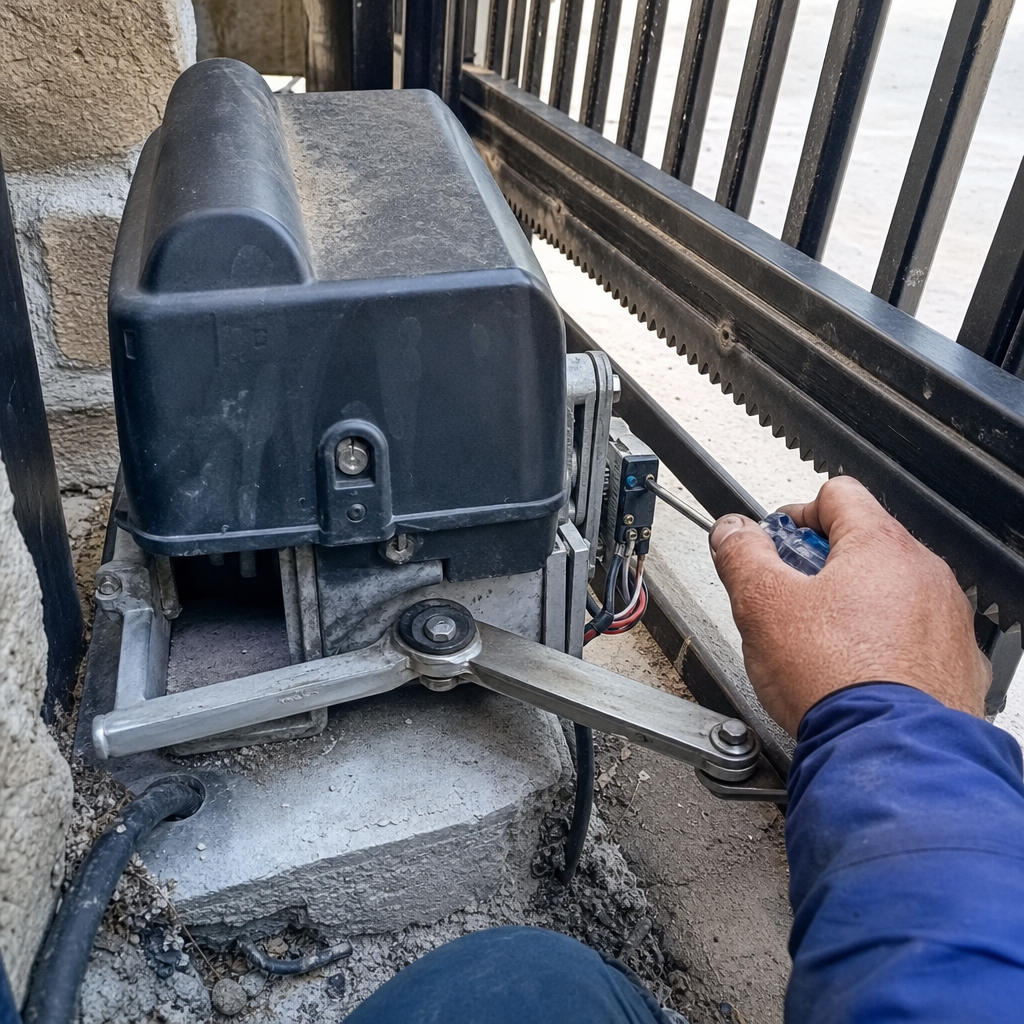
On worm-drive operators like many LiftMaster and Elite models, the limit switch cams set the open and close stop positions. These cams are plastic-on-metal contact points that need a thin film of white lithium grease annually. Without it, they wear unevenly, and the gate starts stopping short or running past its endpoint. We see this constantly in Frisco homes with operators that are three or more years old and have never had this point serviced.
3. The Chain or Rack Gear Teeth (Not Just the Rail)
Most people spray the chain or rack rail surface. The teeth of the pinion gear that meshes with the rack also need lubrication — specifically the gear teeth on FAAC, BFT, and Viking slide operators. A dry pinion gear wears the rack teeth flat over time. Replacing a rack section on a 40-foot driveway gate runs $180–$350 in parts alone. A quarterly wipe of the pinion gear teeth with lithium grease costs nothing.
How to Inspect a Gate Post for Soil-Heave Damage
Frisco sits on Blackland Prairie clay — one of the most expansive soil types in the country. The soil swells with moisture and shrinks in drought, and that cycle puts lateral and vertical stress on gate posts year-round. Here’s how to check a post before the problem becomes a structural repair.
- Check the post plumb with a 4-foot level. Place it on two faces of the post (front and side). Any deviation beyond ¼ inch per foot means the footing has shifted and the gate’s hinge alignment will be affected.
- Look at the base gap. Crouch down and look at the gap between the gate and the ground at the hinge post. If the gap is uneven — wider at the top than the bottom, or vice versa — the post has tilted.
- Push and pull the post by hand. There should be zero movement. Any rock or wobble means the concrete footing has broken its bond with the surrounding soil, which happens most often after a wet winter followed by a dry spring.
- Inspect the concrete collar at grade level. Heaving often shows as a hairline crack where the concrete meets the soil, or as a visible gap on one side. Water pools in this gap, accelerates the freeze-thaw cycle in winter, and the cycle repeats.
- Check the weld at the hinge plate. A tilting post stresses the weld between the hinge mounting plate and the post. Run your fingers across the weld and look for cracking or separation at the edges.
In our experience across Frisco neighborhoods like Phillips Creek Ranch, Richwoods, and Frisco Lakes, post-heave issues are most common on gates installed without adequate footing depth. North Texas code generally requires footings to extend below the frost line, but older or improperly installed posts often fall short of that. If the post has moved more than ½ inch out of plumb, it needs professional assessment — see our guide on Gate Repair Permits, Codes & Inspections in TX: What You Need to Know — before it becomes a gate-out-of-service problem.
Battery Backup Health Checks in Texas Heat
This is the single most underestimated maintenance item on residential gates in Frisco. Here’s the core fact: sealed lead-acid batteries — the type used in most gate operator UPS systems — are rated for a lifespan based on an assumed ambient temperature of 77°F. For every 15°F above that baseline, the rated lifespan cuts roughly in half. Frisco’s garage and exterior enclosure temperatures regularly exceed 120°F in July and August, which means a battery rated for 3–5 years may effectively be dead in 18–24 months.
The failure mode is invisible until it matters: the gate works fine on grid power all summer, then a storm knocks out electricity and the backup doesn’t activate. Or the power blips at 2 AM and the gate won’t open in the morning.
Battery Backup Inspection Steps
- Check the battery voltage with a multimeter. A fully charged 12V sealed lead-acid battery should read 12.7–12.8V at rest. Below 12.4V means degraded capacity. Below 12.0V means replace immediately.
- Check the battery date code. Most batteries have a manufacturing date stamped on the casing. In Frisco’s climate, replace any backup battery that is 18 months or older, regardless of voltage reading — heat damage is cumulative and not always reflected in resting voltage.
- Test actual backup operation. With the gate closed, cut power at the breaker and attempt to cycle the gate twice. It should complete both cycles cleanly. One weak cycle or no movement at all means the battery needs replacement.
- Inspect the terminal connections. Heat causes terminal corrosion faster in Texas than in northern climates. Clean any white or green oxidation with a wire brush and apply battery terminal grease.
LiftMaster, FAAC, and DoorKing operators each use different battery form factors — always confirm the correct amp-hour rating before replacing, as an undersized battery won’t sustain multiple cycles during an extended outage.
Sounds and Behaviors: Call Now vs. Watch It
Seventeen years of gate diagnosis comes down to pattern recognition. Here’s a plain-language guide to what a gate is telling you.
Call Now
- Grinding metal-on-metal sound during travel. This is a dry or seized pivot point, a worn rack-and-pinion mesh, or a failing motor gear. Running it further damages surrounding components.
- Gate reverses partway through the cycle without obstruction. This is typically a limit switch failure, a motor thermal cutout, or — in summer — a photo-eye misaligned by thermal expansion. Don’t keep cycling it to test.
- Visible cracking or separation at a weld joint. A cracking weld under load can fail catastrophically. A 400-pound iron gate dropping off a failing hinge is a serious safety hazard.
- Burning smell from the motor housing. The motor is overheating. Continuing to operate it risks winding failure, which turns a $150 repair into a $400–$700 motor replacement.
- Gate moves significantly when pushed by hand (when motor is off). This indicates a broken or slipped anti-drift mechanism — the gate is unsecured.
Watch It for One Week
- Slightly slower open or close speed. Could be early lubrication wear, a marginal battery, or a minor limit switch drift. Log it, lubricate the main points, and observe.
- Occasional missed keypad entry. Could be a dying keypad battery (on wireless keypads like Ghost Controls and Mighty Mule systems) or intermittent RF interference. Replace the battery first.
- Minor paint chipping or surface rust on the gate frame. Not urgent, but address it within a month — Frisco’s heat accelerates rust spread on bare metal faster than in milder climates.
Electrical and Access-Control Weatherproofing
August in Frisco regularly delivers 3–5 inches of rain in a matter of days after months of dry heat. Electrical enclosures that cracked or had their seals dried out over the summer are suddenly underwater. This is when control boards fail, keypad wiring corrodes, and access-control systems go offline.
Pre-Monsoon Inspection (Late July)
- Open every electrical enclosure on the system. Look for cracked housing plastic, missing or compressed gaskets, and any evidence of prior water intrusion (mineral staining, corrosion on terminal screws).
- Reseal any enclosure with degraded gaskets using silicone-based sealant rated for exterior use. Do not use foam tape — it compresses permanently and loses its seal within one season in Texas heat.
- Check conduit entry points where wiring enters the enclosure. These should be sealed with conduit fitting compound or waterproof wire entry seals.
- On DoorKing and Viking access-control systems, confirm that the telephone entry board’s transformer is properly secured and that no wiring has chafed against the enclosure edge — vibration from gate cycles will eventually cut through insulation.
Post-Monsoon Inspection (September)
- Open enclosures again and look for any new water marks or corrosion that developed during August.
- Test every function of the access-control system: keypad codes, remote FOBs, loop detectors if present, and intercom audio if applicable.
- If the system uses a cellular communicator (common on newer Linear and DoorKing installations in Frisco master-planned communities), confirm signal strength hasn’t been compromised by antenna connection corrosion.
Full Hardware Inspection Checklist
Run through this list quarterly. It takes about 20 minutes and catches the majority of developing problems before they become failures.
- Hinges: Check all hinge barrels for vertical play (more than 1/8 inch means the barrel is worn). Check hinge mounting bolts for tightness. Lubricate pivot points with a grease gun.
- Gate frame: Inspect all welded joints for cracking or separation. Look at the corners and the hinge plate attachment points first — these take the most stress.
- Posts: Check plumb with a level on two faces. Look for movement at the base and cracking in the concrete collar.
- Motor/operator: Cycle the gate three times and listen for unusual sounds. Check the operator mounting bolts. Confirm the manual release works smoothly.
- Drive mechanism: Lubricate chain, belt, or rack-and-pinion as appropriate for your operator type. Check chain tension — a loose chain skips under load.
- Safety sensors/photo-eyes: Clean lens faces with a dry cloth. Confirm the indicator light on each sensor is solid (not blinking). Test obstruction reversal by blocking the beam mid-cycle.
- Battery backup: Test voltage. Confirm backup operation by cutting breaker power and cycling the gate.
- Limit switches: Confirm the gate stops cleanly at fully open and fully closed positions without banging or running long.
- Access control: Test all entry methods — keypad, remote, loop detector, intercom. Confirm all user codes are current.
- Weatherproofing: Check all enclosure gaskets and conduit seals.
Common Mistakes to Avoid
- Using WD-40 as a gate lubricant. WD-40 is a solvent and water displacer, not a long-term lubricant. It strips existing grease, leaves a residue that attracts dust, and provides no lasting protection on Frisco’s high-cycle gate hinges. Use lithium-based grease or a dedicated chain lubricant.
- Ignoring slow gate speed in summer. A gate that runs 20–30% slower than normal in July is usually signaling motor thermal stress or a chain/rack lubrication issue. Left alone, it escalates to a full motor failure during peak heat — typically at the worst possible time.
- Replacing only one side of a dual-swing gate’s hardware. When one hinge fails on a dual-swing gate, the second hinge is almost always at the same wear stage. Replacing only the failed side means the second failure follows within one to two seasons. We see this regularly on older iron gates in Frisco’s established neighborhoods.
- Skipping post inspection after a dry summer. Frisco’s clay soil is most contracted — and most prone to leaving a post footing unsupported — at the end of a long dry summer. A post that was plumb in March may have developed a lean by September. Don’t assume it’s fine without checking.
- Over-tightening limit switches to compensate for a slow gate. Adjusting limit switches to make a slow gate appear to stop correctly is masking a motor or drive problem. The real cause doesn’t go away — it just presents differently until the motor fails.
- Neglecting battery replacement on a schedule. Waiting for a backup battery to fail before replacing it means your gate will fail during a power outage — which is exactly when you need it most. In Frisco’s climate, treat a 24-month replacement schedule as the standard, regardless of what the rated lifespan says.
- Using the wrong lubricant on a belt-drive operator. Belt-drive systems on certain LiftMaster and Elite operators require no lubrication on the belt itself — applying chain grease or lithium grease will degrade the belt material. Check the operator manual or call before lubricating any belt-drive system.
When to Call a Professional
Some maintenance tasks — cleaning sensor lenses, replacing a keypad battery, or cycling the gate to check response times — are straightforward for any homeowner. Others are not safe or cost-effective to handle without specialized equipment and experience.
Call a professional when you see:
- Any weld cracking, hinge barrel failure, or post movement beyond ¼ inch out of plumb
- A motor that smells hot, runs continuously without stopping, or fails to complete a cycle
- Water intrusion in the main control board enclosure
- A gate that reverses on its own or won’t hold position
- Any access-control programming issue on DoorKing, Viking, or FAAC systems — these require brand-specific software and credentials
- Structural damage to the gate frame, posts, or drive mechanism
For any of these situations — or if you just want a professional eyes-on evaluation before problems develop — Gate Repair in Frisco is what Smart Choice Gate Repair Frisco does exclusively. Jeffrey Walker offers free estimates with no pressure. Call (940) 202-9941 to schedule.
Frequently Asked Questions
Frisco gates need maintenance four times per year at minimum — not the twice-yearly schedule most manufacturers assume. The March inspection catches post movement from winter rain cycles, June addresses UV and heat damage before peak summer, September checks for monsoon water intrusion, and December prepares electrical components for freeze conditions. Homes in Frisco’s master-planned communities with high daily gate cycles (Phillips Creek Ranch, Richwoods, Stonebriar) often benefit from quarterly lubrication on top of those four seasonal checks. Call (940) 202-9941 if you’d like a professional inspection scheduled around this calendar.
Use white lithium grease applied with a grease gun — not spray lubricant, not WD-40, and not general-purpose oil. For rack-and-pinion systems on FAAC, BFT, and Viking slide operators, use a dedicated rack lubricant or heavy-duty lithium grease on the rack teeth and pinion gear. Belt-drive systems on certain LiftMaster models require no lubricant on the belt itself. When in doubt, check your operator manual or call (940) 202-9941 before applying anything — the wrong lubricant on a belt-drive can cause more damage than no lubricant at all.
Check the post with a 4-foot level on two faces — front and side. Any lean beyond ¼ inch per foot is significant. Also look at the gap between the gate and the ground along the hinge side: an uneven gap (wider at top or bottom) means the post has tilted. Push and pull the post by hand with the motor disconnected — there should be zero movement. If you feel any rock or wobble, the footing has lost its bond with the surrounding soil and needs professional assessment before the hinge alignment deteriorates further.
Sealed lead-acid backup batteries are rated based on a 77°F ambient temperature. In Frisco’s summer conditions, where enclosure temperatures regularly exceed 120°F, that rated lifespan is cut roughly in half — meaning a 3–5 year battery may effectively be exhausted in 18–24 months. Test battery voltage quarterly with a multimeter (a healthy 12V battery reads 12.7–12.8V at rest) and replace on a 24-month schedule regardless of what the label says. Waiting for a backup to fail means your gate won’t open during the next power outage.
Basic Mighty Mule and Ghost Controls swing-arm operators are designed for DIY installation and are a reasonable self-install project for a mechanically capable homeowner. Commercial-grade operators like FAAC, BFT, and Viking slide systems involve 120V wiring, precise torque settings, limit switch calibration, and — in many Frisco HOA communities — specific access-control integration requirements. Incorrect installation voids warranties, and a miswired operator can destroy a new control board in its first power-on cycle. For anything beyond a basic swing-arm on a small pedestrian or driveway gate, Gate Installation in Frisco by a specialist saves money over time. Call (940) 202-9941 for a free installation estimate.
In 17 years working specifically in Frisco and surrounding Collin County, the most frequent failures we see are: hinge pivot pin seizure from missed lubrication, gate post heave from clay-soil movement (most common in spring and after wet winters), backup battery failure during summer power outages, photo-eye misalignment from thermal expansion on south-facing sensors, and motor overheating from blocked vents — often caused by wasp nests in FAAC and BFT housings. The Gate Motor & Opener in Frisco service covers most of these motor-side failures. All of them are preventable with consistent maintenance.
The Bottom Line
A gate in Frisco faces conditions that a generic maintenance checklist wasn’t designed for: clay soil that moves seasonally, summer heat that degrades batteries and UV-sensitive components ahead of schedule, and monsoon rain that arrives after months of baking dry conditions. The checklist above — timed to Frisco’s actual climate calendar, focused on the three lubrication points most homeowners miss, and built around real failure patterns from years of local fieldwork — gives you what you need to keep your gate running without surprises. Stay on the four-season schedule, replace backup batteries every 24 months, and check your posts every spring and fall. The inspections are straightforward. The failures are expensive. The math makes the maintenance worth it. For more guides & resources, visit our blog.
If you’d like Jeffrey Walker to run through this checklist on your gate — or if something in this guide flagged an issue you want looked at — call (940) 202-9941 for a free estimate. Smart Choice Gate Repair Frisco handles Smart Choice Gate Repair Frisco home — from a single hinge repair to a full operator replacement — with no subcontractors, no guesswork, and 334 reviews from Frisco homeowners who didn’t need to call twice.
Written by Jeffrey Walker, Owner & Lead Technician at Smart Choice Gate Repair Frisco, serving Frisco since 2009.