
Last updated July 15, 2026
Seasonal Gate Repair Care for Frisco: Year-Round Homeowner’s Guide
Most gate failures don’t happen without warning — they happen because a homeowner missed the warning three months earlier. In Frisco, that gap usually falls between a brutal summer and a surprise ice event, and the gate that seemed “a little sluggish” in October becomes a dead opener in February. This guide is built around Frisco’s actual weather calendar — two punishing seasons and two maintenance windows — so you know exactly what to do, when to do it, and what to look for before a minor issue becomes a three-week gate repair backlog.
Quick Answer
Frisco’s gate maintenance calendar is defined by extremes: sustained 100°F+ summers stress hydraulic seals, circuit boards, and lubricants, while winter ice events freeze actuators and crack conduit. The highest-return maintenance windows are fall (before the first freeze) and spring (after freeze-thaw cycles stress posts and concrete). Staying on that two-window inspection rhythm catches the majority of gate failures before they become emergency calls.
Table of Contents
- How Frisco’s Climate Actually Affects Your Gate
- Summer Gate Failures: What 100°F Does to Your System
- Fall Prep: The Highest-ROI Maintenance Window
- North Texas Winterization: What Actually Matters Here
- Spring Inspection: The Post-Freeze-Thaw Checklist
- Frisco’s Clay Soil and Gate Alignment: A Year-Round Variable
- Common Mistakes to Avoid
- When to Call a Professional
- Frequently Asked Questions
- The Bottom Line
How Frisco’s Climate Actually Affects Your Gate
Generic gate maintenance guides are written for a temperate, four-season climate. Frisco doesn’t have one. What we have is a heat season that runs from late May through September, a short and unpredictable freeze window from late November through February, and two narrow transition periods in spring and fall where the real maintenance work should happen.
That pattern matters because gate systems fail differently in heat than they do in a freeze, and the repairs that pile up after a February ice storm are almost always the deferred maintenance from the previous fall. When Uri hit the Dallas-Fort Worth area in 2021, the calls we fielded in Frisco were almost entirely from homeowners who’d noticed a slow gate or a warning light in October and decided to wait. They waited until March — because that’s how long the backlog ran.
Understanding your gate’s seasonal stress cycle means you’re not reacting to failures — you’re preventing them. The sections below break down each season by the specific failure modes it creates, so you can match your inspection checklist to the actual threat at the right time of year. For a deeper dive, see our Complete Guide to Gate Repair in Frisco.
- Peak heat season (June–September): electrical, hydraulic, and rubber seal failures dominate
- Ice event window (December–February): actuator freeze, conduit cracking, and board shorts
- Fall (October–November): best window to find summer damage before winter compounds it
- Spring (March–April): best window to assess freeze-thaw damage to posts, concrete, and alignment
Summer Gate Failures: What 100°F Does to Your System
When Frisco hits its third consecutive week above 100°F — and it does, reliably, every summer — your gate’s components are under thermal stress that most homeowners don’t think about until something stops moving.
Here’s what’s actually happening inside the operator housing during a North Texas summer:
- Hydraulic fluid viscosity: FAAC and BFT hydraulic operators rely on fluid that thins significantly above 90°F. In sustained 100°F+ heat, over-thinned fluid reduces actuator force and can cause slow, jerky, or incomplete gate travel. If your swing gate started moving slowly in July, this is the first thing to check.
- Circuit board behavior: Control boards in LiftMaster, Linear, and Elite operators are rated for a temperature range, and direct west-facing sun on an unventilated housing can push internal temps well past 140°F. Heat-induced board failures mimic wiring faults — intermittent operation, random resets — and are frequently misdiagnosed.
- Rubber seals and gaskets: The seals on hydraulic operators dry, crack, and begin weeping fluid in sustained heat. Once seals go, hydraulic fluid contamination typically follows, and that’s a costlier repair than a $40 seal kit caught in time.
- Battery backup systems: Ghost Controls and Mighty Mule systems that rely on battery backup see dramatically shortened cycle counts in heat. A battery that works fine in March may fail to open the gate once after sitting at 105°F all afternoon.
- Solar charging panels: Counterintuitively, extreme heat reduces solar panel efficiency. If your gate runs on solar, peak summer is when you’re most likely to see low-battery warnings.
During summer, run your gate five or six times and watch it. Sluggish travel, grinding sounds, or incomplete cycles in the heat are diagnostic signals — not minor quirks to ignore until fall.
Fall Prep: The Highest-ROI Maintenance Window
October and November are the most valuable two months on your gate maintenance calendar. The heat stress of summer is done, the ground has stabilized, and you still have weeks before the first hard freeze arrives. Everything you don’t address now becomes an emergency in January.
Fall is the window where Jeffrey Walker and our team at Smart Choice Gate Repair Frisco home see the clearest diagnostic picture — summer failures are fresh, and there’s still time to order parts and complete repairs before the weather turns.
Here’s the fall inspection protocol we recommend for Frisco homeowners:
- Run a full cycle count test. Open and close the gate 10 times in a row. Count how many cycles complete cleanly. Any hesitation, reversal, or incomplete travel on those cycles is a problem to diagnose now, not February.
- Check hydraulic fluid level and condition. For FAAC, BFT, and similar hydraulic operators, pull the reservoir cap or inspection port and look at fluid color. Dark, cloudy, or gritty fluid means contamination — it should be replaced before cold weather thickens it further.
- Inspect all rubber seals and gaskets. Look for surface cracking on any exposed rubber components. A seal that survived summer may not survive a freeze-thaw cycle.
- Test your battery backup. Disconnect shore power and run the gate on battery alone. If it won’t complete a full open-close cycle on battery, replace the battery before winter. Ghost Controls and Mighty Mule batteries are especially vulnerable after a hot summer.
- Lubricate all moving hardware. Hinges, rollers, chains, pivot points — use a lithium-based grease rated for temperature extremes. Avoid WD-40, which evaporates and leaves metal unprotected through freeze cycles.
- Inspect conduit and wiring runs. Look for PVC conduit sections that show surface stress cracks from summer UV exposure. Cracked conduit admits moisture, and moisture plus a freeze equals a cracked conduit section and shorted wiring.
- Check gate alignment and post plumb. Summer heat and Frisco’s clay soil shift posts. A gate that’s rubbing the strike plate or dragging on the ground in October needs alignment before winter freeze locks that geometry in place.
- Test all access control components. Keypads, vehicle loops, intercoms, and DoorKing or Viking access systems should be tested with fresh battery backups and firmware current before temperatures drop.
North Texas Winterization: What Actually Matters Here
Frisco doesn’t need the winterization protocol written for Minnesota. We don’t have six months of below-freezing temperatures, and the steps designed for that climate — draining hydraulic systems entirely, removing operators, pulling batteries indoors — are overkill here and can introduce new problems if you’re not careful about reassembly in spring.
What Frisco does get is sudden, hard freezes — often preceded by sleet and freezing rain that coat every metal surface with a layer of ice before temperatures drop into the teens or single digits. That event profile creates specific failure modes:
- Actuator freeze: Water that infiltrated a hydraulic operator’s vent or seals during a rain event freezes solid. The operator won’t move until it thaws, and forcing it damages the actuator arm or gears. The fix is to let it thaw — or call us if you need access quickly.
- Cracked PVC conduit: Water sitting in a surface crack freezes, expands, and splits the conduit. This is how a minor cosmetic crack from August UV exposure becomes a wiring exposure and a board short in February.
- Control board shorts from condensation: Rapid temperature swings — 65°F on Tuesday, 17°F on Thursday — cause condensation inside operator housings. If the housing seal is compromised, that moisture reaches the board.
- Gate panel ice loading: Heavy sleet accumulation on a cantilevered slide gate or a wide swing gate can double the effective gate weight. Operators not sized correctly for that load will trip overload protection or strip gears.
The practical winterization checklist for Frisco:
- Confirm housing seals are intact and gasketed properly
- Apply a penetrating lubricant to hinge pins before the first freeze forecast
- Confirm the operator’s internal heater is functional if your unit has one (many FAAC and BFT models do)
- Clear any standing water from the gate track on slide gates before a freeze forecast
- Check that conduit entries into housings are sealed with silicone or foam backer
Spring Inspection: The Post-Freeze-Thaw Checklist
March in Frisco is gate inspection month whether you planned it or not. The freeze-thaw cycles of December through February have done their work on your posts, concrete footings, and hardware — and now it’s time to see what they left behind before spring storms add another round of stress.
The key spring inspection items in Frisco are structural, not electrical. Winter damage to electrical components usually shows up as an acute failure during the event. Post and footing damage shows up slowly, over weeks, as alignment drifts.
- Check post plumb in both directions. Use a level on each gate post. Clay soil heave from freeze-thaw cycles is the most common cause of gate misalignment in Frisco, and posts that moved even half an inch off plumb can cause binding, motor strain, or rubber seal wear on operators.
- Inspect concrete footings for heave and cracking. Look at the concrete collar at each post base. Cracking that follows the post line indicates heave. This is a structural repair, and it needs to be addressed before you adjust the operator — otherwise you’re tuning to a moving target.
- Check hinge bolt torque. Freeze-thaw cycling loosens hardware. Hinge bolts that backed out 1/8″ over winter allow gate sag that the operator has to compensate for on every cycle.
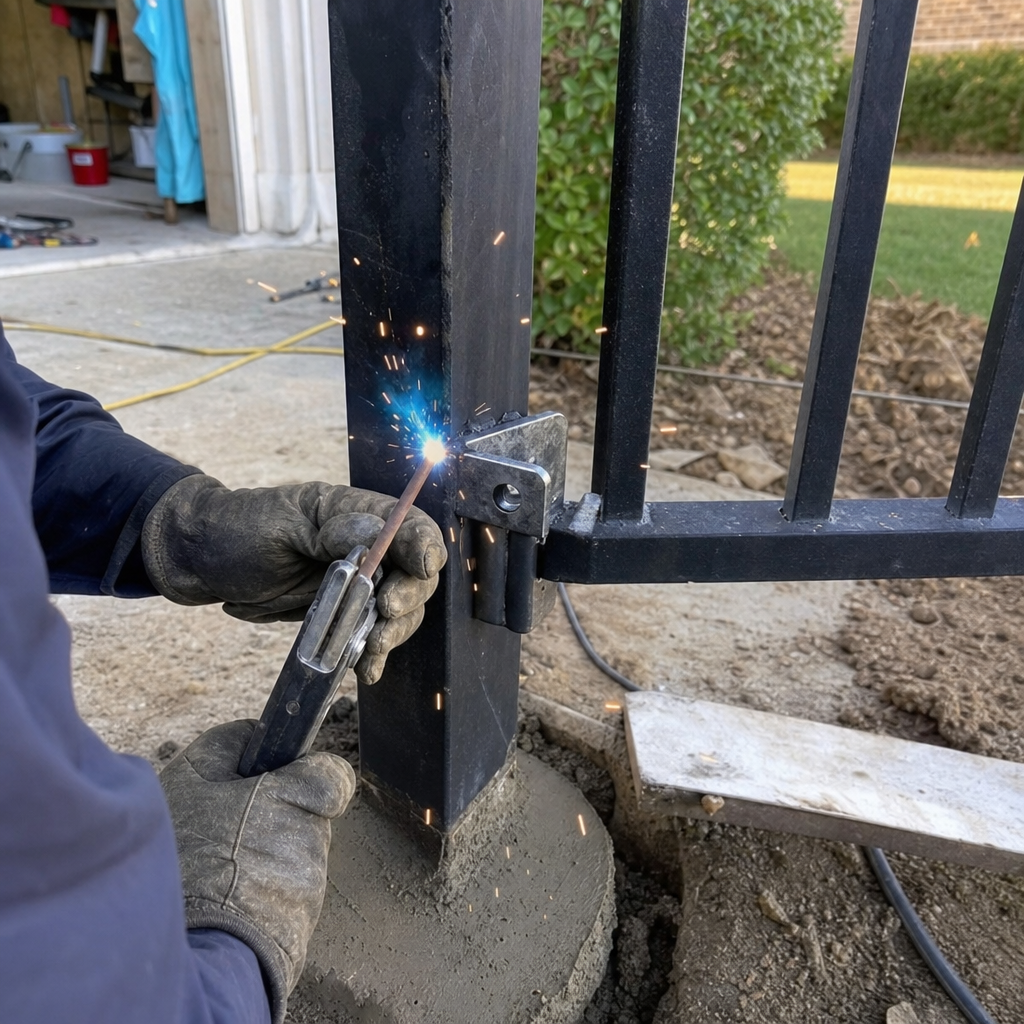
- Inspect weld points on the gate frame. Look for hairline cracks at welded joints, especially on heavier iron or steel gates. A weld crack caught in spring is a grinder-and-rod repair. Ignored through summer, it becomes a structural failure.
- Lubricate everything again. The lithium grease you applied in fall has been through temperature extremes. Spring is the second lubrication window.
- Test the safety reversal function. If your gate’s safety loop or photo-eye was affected by winter, the reversal system may not be functioning correctly. This is a safety issue, not a convenience issue.
For homeowners in Frisco’s newer master-planned communities — Starwood, Newman Village, Phillips Creek Ranch — we see heavier clay soil content that makes post heave more pronounced than in older established areas closer to the 380 corridor. If your neighborhood sits on that heavy black clay, a spring post inspection isn’t optional.
Frisco’s Clay Soil and Gate Alignment: A Year-Round Variable
Frisco sits on expansive clay soil — the kind that swells with moisture and contracts in drought. That’s not a one-season problem; it’s a continuous mechanical force acting on every buried post and concrete footing on your property, in every direction, all year.
The practical consequence for gate owners: alignment is a twice-yearly check, not a one-time setting. A gate that was perfectly plumb and gap-consistent when installed may need adjustment six months later not because anything broke, but because the ground moved.
Here’s how the soil cycle maps to Frisco’s weather:
- Late spring (May): Soil is often at maximum expansion from spring rains. Posts may have shifted outward from swelling pressure.
- Late summer (August–September): Extended drought and heat shrink the clay significantly. Posts can rack inward. Gates that cleared the ground in May may drag in September.
- After freeze events: Freeze-thaw cycles add a vertical heave component. Posts that were level can rise slightly, changing the gate’s attitude relative to the strike plate and operator arm.
What this means practically: set aside time in November and again in March to check gate alignment independent of any other maintenance. Run the gate through five cycles and observe the gap at the top, bottom, and latch side. Any tightening or rubbing that wasn’t present six months ago is a soil-movement signal, not a coincidence.
We also strongly recommend that any new gate installation in Frisco use concrete footings poured to a depth that reaches below the active soil zone — typically 36–42 inches in this area. Shallower pours are why we see posts rocking in three-year-old installations in neighborhoods like Grayhawk and Trails of Frisco.
Common Mistakes to Avoid
- Using WD-40 on gate hardware. WD-40 is a solvent, not a lubricant. It displaces moisture temporarily but leaves moving parts unprotected within days. In Frisco’s heat, it evaporates almost immediately. Use lithium-based grease or a dedicated gate lubricant rated for temperature extremes.
- Ignoring a slow gate in summer and blaming the heat. “It’s just because it’s hot” is the most expensive sentence a Frisco gate owner says. A slow gate in July is diagnosing itself — hydraulic fluid thinning, a weak battery, or a board running hot. Heat reveals problems; it doesn’t create them from nothing.
- Applying Northern-state winterization steps to a Frisco gate. Draining hydraulic reservoirs entirely or removing operator arms for storage is the right move in Minnesota. In Frisco, it introduces reassembly errors and typically leaves the gate non-functional through a mild winter that never warranted the effort. Match your winterization to our actual freeze profile.
- Skipping the spring structural inspection because the gate “seems fine.” Gate alignment on expansive clay soil drifts gradually. By the time it’s visibly wrong, the operator has been under abnormal strain for months. The March inspection is specifically for catching the drift before the motor pays for it.
- Replacing the opener without addressing the underlying mechanical issue. A new LiftMaster or FAAC operator installed on a gate with misaligned posts or dragging hardware will fail prematurely for the same reason the old one did. The motor is almost never the root cause — it’s a symptom of a structural or alignment problem.
- Letting battery backup go untested through summer. Batteries that sit unused in a 100°F+ operator housing through three months of heat degrade silently. The first time you need battery backup — a power outage during an ice event — is the worst time to find out it won’t hold a charge.
- Delaying repairs because the gate “still works.” A gate that opens slowly, reverses unexpectedly, or requires two button presses is not a functional gate — it’s a gate in the early stages of a failure. In Frisco, deferred repairs regularly turn a $150 service call into a $600+ emergency job after the next weather event finishes what summer started.
When to Call a Professional
Some gate maintenance genuinely is homeowner territory: lubricating hinges, cleaning sensors, testing battery cycles, and clearing debris from a slide gate track. A lot of it isn’t — and knowing the difference keeps you from turning a small problem into a larger one.
Call a gate specialist when you see any of these:
- The gate reverses mid-travel without obstruction (safety loop or board fault)
- A hydraulic operator moves slowly regardless of temperature (fluid or seal issue)
- A post is visibly out of plumb or a footing shows heave cracking
- The control board shows fault codes you can’t clear with a reset
- A weld crack appears on the gate frame or hinge plate
- The gate won’t open after a freeze event and you need access
- Any wiring damage from conduit cracking or rodent activity
Gate Repair in Frisco — particularly the structural and electrical work — requires the right diagnostic tools and brand-specific knowledge to avoid creating secondary damage. Smart Choice Gate Repair Frisco offers free estimates in Frisco — call (940) 202-9941 and Jeffrey Walker will assess the job directly.
Frequently Asked Questions
How often should I service my gate in Frisco?
Twice a year is the practical minimum for Frisco — once in fall (October–November) before the freeze window, and once in spring (March) after freeze-thaw cycles have finished with your posts and footings. Gates with high daily cycle counts — busy households, short driveways with frequent access — benefit from a mid-summer check as well, specifically to catch battery and hydraulic fluid issues before they compound through the heat season.
What’s the most common gate failure in Frisco summers?
Hydraulic operator slowdown is the most common call we get June through August in Frisco. When sustained temperatures exceed 100°F, hydraulic fluid in FAAC and BFT swing operators thins past its effective viscosity range, reducing actuator force. The gate moves slowly or stops mid-travel. The fix is typically a fluid change and a seal inspection — caught early, it’s straightforward. Call (940) 202-9941 for a free assessment if your gate is sluggish in the heat.
Do I need to winterize my gate in Frisco?
Yes, but not the way Northern-state guides describe it. Frisco’s threat is sudden hard freezes with ice accumulation, not sustained sub-zero cold. The relevant steps are sealing housing entry points to prevent condensation, lubricating hinge pins before freeze forecasts, confirming your operator’s internal heater works if it has one, and clearing slide gate tracks before standing water freezes in place. Draining hydraulic systems or removing operators for storage is unnecessary here and typically counterproductive.
Why does my gate keep going out of alignment in Frisco?
Frisco’s expansive black clay soil swells and contracts with moisture and temperature changes across every season. That movement applies continuous lateral and vertical pressure to gate posts and concrete footings. A gate that was perfectly aligned at installation can drift measurably over six months without anything “breaking.” The solution is a twice-yearly alignment check — spring and fall — and ensuring original post footings were poured deep enough to reach below the active soil zone, typically 36–42 inches in this area.
How do I know if my gate issue is a motor problem or a structural problem?
If the gate moves sluggishly under power but moves freely when disconnected from the operator and pushed by hand, the issue is typically mechanical — binding hinges, misaligned posts, or a dragging gate panel. If it’s stiff by hand too, the issue is structural. If it moves freely by hand but the operator won’t run or runs erratically, the issue is electrical or motor-side. Replacing the opener on a structurally misaligned gate will produce the same failure in the new unit. Call (940) 202-9941 for a diagnostic that separates the two before any parts are ordered.
What gate brands do you service in Frisco?
We work on LiftMaster, FAAC, BFT, Linear, Viking, Ghost Controls, DoorKing, Elite, and Mighty Mule systems — covering the full range of residential gate operators you’ll find across Frisco’s newer developments and established neighborhoods alike. For a Gate Motor & Opener in Frisco repair or replacement, we carry brand-matched parts and don’t subcontract the work. Jeffrey Walker diagnoses and repairs on the same visit in the majority of cases.
The Bottom Line
Frisco’s gate wear doesn’t follow a tidy quarterly schedule — it follows the weather. Two maintenance windows (fall and spring) do the heavy lifting: fall to find and fix what summer heat damaged before winter arrives, and spring to assess what freeze-thaw cycles did to your posts and footings. The homeowners who stay ahead of that rhythm avoid emergency calls, extended backlogs, and the compounding repair costs that come from letting heat damage run through an ice event. The ones who treat gate maintenance as an occasional task pay for it eventually — usually in February, usually at the worst possible time. Use this guide as your recurring reference, and keep (940) 202-9941 in your phone for anything beyond routine lubrication and cleaning. Jeffrey Walker has been doing this work exclusively in Gate Installation in Frisco and repairs for 17 years — the seasonal failures described here aren’t hypothetical. We’ve seen every one of them, and we know how to prevent them.
Ready to schedule a seasonal inspection or have a repair that’s been waiting? Call Smart Choice Gate Repair Frisco at (940) 202-9941 for a free estimate. Jeffrey will take the call, and in most cases he’ll be the one showing up.
Written by Jeffrey Walker, Owner & Lead Technician at Smart Choice Gate Repair Frisco, serving Frisco since 2009. Explore more guides & resources from our team.